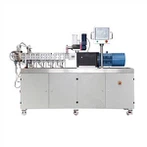
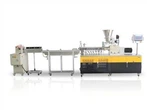
The core reason why laboratory extruders adopt forced feeding is to overcome the drawbacks of gravity feeding such as bridging and air lock when processing materials with low bulk density, high filler loading or powder materials, so as to realize quantitative, continuous feeding with high filling degree.

Core Advantages
- Prevent bridging and material starvation
Powders, recycled materials or highly filled materials easily form arched blockages (bridging) at the hopper outlet, resulting in idle rotation of screws and fluctuating extrusion output. Forced feeding delivers material via mechanical pushing to break static friction and guarantee consistent feeding.
- Remove air and avoid air lock
Free-fall gravity feeding easily entraps air and fluidizes powders, which reduces bulk density and introduces bubbles. Forced feeding (especially low-speed fully-filled design) compacts materials, expels entrapped air, and improves melt compactness and venting performance.
- Overcome back pressure restriction
When high pressure builds up in the melting section of the barrel, gravity feeding cannot counteract reverse pressure, causing blowback or insufficient feeding. The feed screw of forced feeding provides forward thrust to push materials into the high-pressure zone, enabling high-filling processes.
- Achieve precise metering control
Laboratory research requires strict control of formulation ratios. Forced feeding (often combined with loss-in-weight feeders) enables closed-loop control of mass flow, eliminating volumetric metering errors caused by changes in particle shape and humidity.
Applicable Scenarios
- Material Characteristics
Ultrafine powders (nanofillers), low bulk density materials, long fiber reinforced materials, high-viscosity rubber (cold feeding).
- Process Requirements
High-filled modification (filler loading>40%), reactive extrusion (accurate control of additive dosage), heat-sensitive materials (short residence time in feeding zone to reduce thermal degradation).

Key Mechanism
Forced feeding is generally realized by independently driven feed screws (main feeding or side feeding), whose rotating speed can be adjusted separately from the main extruder. Reducing the rotation speed of feed screws keeps screw channels fully filled (opposite logic of starve feeding). The material itself forms a piston effect to seal gas and overcome barrel internal pressure, a physical state impossible to achieve merely by gravity.