Driven by the industrial trend of iterative upgrading for eco-friendly flame-retardant materials, halogen-free formulation, low smoke density, non-toxicity and excellent processability have become core R&D targets for modified PP and TPO compounds. Using polypropylene (PP) as the base resin, toughened with TPO polyolefin elastomer and compounded with eco-friendly halogen-free flame retardants, researchers can fabricate environmentally friendly sheets and films balancing toughness, mechanical strength and flame resistance. These materials are widely applied in automotive interiors, wire & cable sheaths, new energy insulation components, electrical and electronic housings, and comply with environmental regulatory standards including RoHS and REACH. They eliminate the drawbacks of conventional halogenated flame retardants, such as toxic and corrosive flue gas release at high temperatures, heavy smoke generation and environmental contamination.

Within the formulation system, PP delivers fundamental rigidity and forming stability, while TPO effectively remedies PP's inherent weaknesses of severe low-temperature brittleness and poor impact resistance. The halogen-free flame retardant achieves UL94-V0 flame retardancy via synergistic mechanisms including char formation for oxygen barrier, endothermic cooling and smoke suppression.The additive system features outstanding dispersion; additives rarely migrate or bloom out, and discoloration/yellowing is minimized during high-temperature processing, preserving the base material's mechanical properties to the maximum extent.
Nevertheless, this modified system has a narrow process latitude regarding formulation ratio, extrusion plasticization temperature, calender roll gap and line speed. Extensive laboratory trial runs are mandatory before mass production. Conventional large-scale production lines suffer high material consumption, excessive trial costs and cumbersome parameter adjustment during sample testing.
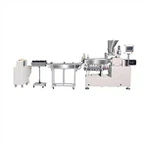
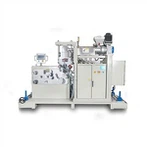
Ordinary equipment fails to meet such stringent process windows. POTOP small-scale precision extrusion calender developed by POTOP is engineered to address R&D pain points for such challenging modified materials, perfectly suited for lab-scale sample preparation and process parameter validation of halogen-free flame-retardant PP+TPO formulations.

The integrated unit consists of a precision single-screw extruder, T-type coat-hanger die, 3-roll calendering forming unit, haul-off & winding system, and an intelligent automatic measurement & control system, fully replicating industrial extrusion and calendering processes for sheets and thick films.Equipped with multi-section independent temperature control, the machine achieves temperature accuracy of ±1°C with a temperature range from ambient temperature to 350°C. It precisely matches the processing temperature requirements of PP, TPO and halogen-free flame-retardant fillers, preventing thermal degradation of flame retardants that would compromise flame resistance, mitigating uneven plasticization, and reducing surface defects such as white spots and delamination on sheets.

The three rolls adopt independent servo synchronous control. Roll gap, roll temperature and line speed are adjustable in multiple dimensions to accurately control sheet thickness, flatness and surface gloss, and resolve forming defects including thin sheet warpage, thickness deviation and surface pitting.The machine produces calendered sheets ranging from 0.2 mm to 1.5 mm in thickness, with a maximum effective forming width of 180 mm. Rolls are treated with mirror chrome plating and polishing. The system adopts Siemens PLC with touchscreen HMI; process parameters including screw speed, roll surface speed, zone temperatures and calendering pressure can be recorded in real time for archiving.

Although halogen-free flame-retardant PP/TPO blends deliver remarkable performance advantages, the narrow process window restricts R&D efficiency. This small-scale extrusion calender replicates the full industrial workflow. Precise control over temperature, rolling pressure and line speed addresses material degradation, insufficient plasticization and surface imperfections. All formulation and process data can be stored and scaled up reliably.It serves as a dependable experimental platform for formula iteration and mass-production process confirmation of halogen-free low-smoke flame-retardant polyolefin sheets, supporting the continuous advancement of flame-retardant modified polyolefins toward higher environmental performance, superior mechanical properties and better manufacturability.