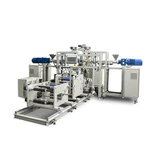
In the field of film production, "blow molding" and "casting" are two of the more commonly used processes. The following is a brief introduction and comparison of the two most commonly used production processes in film production.
Multilayer coextrusion blow molding
This production process is mainly divided into two forms: upper air cooling and lower water cooling. Upper air cooling is mainly composed of multiple extruders, multi-layer superimposed die heads, multi-air outlet air rings, IBC internal cooling system, herringbone splints, rotating traction system, lower traction system and winding system.
Multi-layer co-extrusion casting
This production process mainly consists of multiple extruders, multi-channel distributors (commonly known as "aggregators"), T-die heads, casting systems, horizontal traction systems, oscillators, and winding systems. The main characteristics of this production process are that the film products produced have good surface gloss, high flatness, small thickness tolerance, good mechanical elongation properties, good flexibility, and higher transparency than the blow molding method.
Comparison between film blowing and casting
Blow molding and cast film are the two main production processes for polyolefin film production and processing. Blow molding was used earlier in the production and processing of films. Due to the limitations of its production process and the insurmountable defects of its products, in the 1980s, a more advanced film production cast film method was gradually developed, especially the use of multi-layer co-extrusion technology, which enabled the film production and processing technology of the cast film method to be widely promoted and applied, and gradually applied to high-end packaging of various items with its high-quality product characteristics, while the blow molding method, due to its inherent defects, can only meet the packaging of ordinary medium and low-end products.
Production process comparison
1. Casting is more suitable for multi-layer co-extruded film production and processing than blow molding, especially when using a variety of different materials for co-extrusion. The production process parameters of the casting method are easier to control, and the design of the die head, the key part of the processing equipment, can more effectively ensure the uniformity of the distribution of various materials in the product. The multi-layer co-extrusion die head of the blow molding method is more difficult, the structure is more complex and the technology is not mature enough.
2. In the processing equipment of the casting method, the distance from the die head to the cold roller (forming to shaping) is generally 10-20mm, the melt film curtain is very short and is quickly shaped with the help of the vacuum suction hood, air knife and edge fixing device, and the product quality is good and stable. In the blow molding method, the melt film has a blowing process and relies on air or water to cool and shape. The shaping time of the product is too long and the changes before shaping are large (generally 4-7 times of blowing). It is easy to be affected by external and internal factors in the melt film stage, and the product quality control is very difficult and the stability is poor.
3. There are also great differences between blow molding and cast film in the selection of raw materials. In multi-layer co-extrusion, blow molding requires the selection of materials with similar fluidity to match each other as much as possible. When the fluidity of the materials differs greatly, there is a lack of corresponding measures to adjust them. Therefore, when one of the materials is selected, there is not much choice for other materials co-extruded with it. This greatly restricts the embodiment of the advantages of multi-layer co-extrusion processing technology in product quality. The processing equipment of the cast film method can easily solve the problems that are almost unsolvable in the blow molding method by adjusting the diverter channel.
Product Features Comparison
1. Blow molding has a blowing process, which causes the longitudinal and transverse molecules of the product to be stretched to varying degrees. The temperature resistance and heat sealing performance of the product will be greatly affected. When the product needs to be boiled and sterilized (such as 121°C steam), the molecular chains stretched during molding will shrink significantly after being heated, resulting in serious deformation of the product, and will greatly reduce the strength of the heat-sealed joints and cause bag leakage.
2. When the cast film method is used to produce film (also known as unstretched film), the molecules are arranged in an orderly manner and the product cools quickly, which is conducive to improving the transparency, glossiness and thickness uniformity of the product, and the product texture is softer and tougher; the impact resistance, heat resistance and low temperature adaptability are better than the blow molding method.
3. The cast film method has extremely high production efficiency and good product quality stability. There is less waste in the production process, and it is easier to realize online recycling of edges and waste, and the material utilization rate is high.
4. The cast film method uses a flat die head with a special retention groove inside the die head to ensure uniformity of material flow, and the uniformity of the die lip gap can be automatically controlled by the automatic adjustment device of the die head. The control accuracy is very high, and thicker films can be controlled below ±3%. The annular die head and multi-layered core used in the blow molding method have very high requirements for processing accuracy and assembly accuracy and are particularly difficult to control. If there are slight errors in processing and matching accuracy, they cannot be compensated by adjustment. Therefore, the thickness tolerance of the product is basically around ±10%. For a 200μm thick film, it means that the thinnest part is 180μm and the thickest part may be 220μm. When welding and sealing bags, no matter how the mold gap and heat sealing temperature are adjusted, it is difficult to ensure that the thickest and thinnest parts can achieve the required sealing strength. Leakage is inevitable, and the yield rate is naturally very low.
5. For materials with low melt strength, the bottom blowing method and water cooling are required. Incomplete drying of moisture or improper selection of materials for the corona layer will lead to poor corona treatment effect or severe corona attenuation. This will affect the adhesion of the printed ink and cause discoloration. The cast film method uses a steel casting roller (with cooling water inside) to cool and shape the film, and moisture does not come into direct contact with the film.
The desktop small precision extrusion cast film blowing machine is composed of a small precision single screw extruder, a screen changer system, a cast film system, a film blowing system, a traction system, a winding system, an edge trimming system and a measurement and control system. It can realize functions such as polymer extrusion, cast film, film blowing, traction, edge trimming and winding.
https://www.potop-polymer.com/lab-blown-film-machine/single-layer-multifunctional-cast-film.html

 facebook
  linkedin
  pinterest
  twitter
  whatsapp
  youtube
  instagram