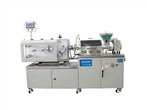
The general production process of waste film recycling and granulation can be roughly divided into the following four parts: the conveying and feeding process of crushed waste film, the re cutting and extrusion process of material compactor, the extrusion plastic molding process of extruder, and the granulation and recycling process of granulator.
1. Conveying and feeding process
Scrap conveying is the step in the work of a granulator. The purpose is to complete the transportation of small film blocks produced by a large film crusher to the feed bin through a conveyor belt. The film waste is driven forward by a three-phase motor on the conveyor belt. A metal detector is installed on the conveyor belt to detect possible metal debris. If there is any metal debris, an alarm will be given, and the operator will press the button to move the conveyor belt backward to detect the metal debris. After that, the waste will continue to be transported into the feeding bin. In the feeding bin, the movement of the feeding motor is regulated by a frequency converter to control the flow of waste to the material compactor system below 。 The conveyor can operate in both automatic and manual modes. Manual mode is only used when starting and closing the conveyor. Normal operation is in automatic mode.
2. Material compaction process
Material compaction is an important process in the work of a granulator. The main purpose is to complete the re cutting of waste materials and the mixing, heating, extrusion, and pre drying processes. The process of material compaction is controlled by an electric motor. During the material compaction process, the heat generated by the friction force melts the waste. After the waste is transported by the conveyor belt to the material compactor, the waste can be mixed, heated, and pre dried in the material compactor. The temperature adjustment of the material compactor can be carried out through the filling rate of the material compactor. High filling rate indicates high temperature, while low filling rate indicates low temperature. The temperature of the material compactor is also related to the output of the granulator, as the output decreases and the temperature decreases. If the temperature of the material compactor is too high, it can be adjusted by starting the cooling water valve. The starting of the material compaction motor is controlled by a starting door, which can realize the starting and emergency stop of the material compaction motor through a control circuit.
3. Extrusion plasticization process
Extrusion plasticization is the most important step in the work of a granulator, with the main purpose of completing the extrusion molding of plastic melt. The film head extrudes the melt into plastic strips, and then passes through the cooling system to enter the granulator for cutting into particles. After entering the extruder, the plastic is bitten by the screw threads of the extruder, and is forced to advance towards the head direction by the screw threads as the screw rotates, forming a mechanical conveying process. When the plastic runs from the feeding port to the machine head, due to the gradual decrease in the thread depth of the screw, as well as the presence of resistance such as the filter screen, the splitter plate, and the machine head, a high pressure is formed during the plastic plasticization process, which compacts the waste material, improves its heat transfer conductivity, and helps the plastic melt quickly. At the same time, the gradually increased pressure allows the gas originally existing between the film waste materials to be discharged from the exhaust hole. As the pressure increases, on the one hand, the plastic is heated externally, and on the other hand, during the movement of compression, shearing, and stirring, due to the internal friction force, a large amount of heat is generated. Under the combined action of external and internal forces, the temperature of the plastic gradually increases, and its physical state also undergoes a change from a glassy state to a highly elastic state to a viscous flow state. At the same time, the plastic gradually melts to achieve complete plasticization of the plastic, Finally, the plasticized plastic is extruded from the machine head at a constant pressure and quantity by the action of screw thrust.
4. Granulation recovery process
Granulation recovery is the final step of the entire granulator operation. The continuously flowing plastic melt from the granulator passes through an annular nozzle and turns into plastic strips. The granulator unit has a rotary cutter to cut these plastic strips. The cut small particles enter the granulator chamber for cooling and molding. After being dried by the dryer, the prepared plastic particles are transported to a storage tank by a discharge device and bagged for completion. The size of the pelletizing chamber is sufficient to allow the pelletizing knife to freely rotate across the mold surface without limiting the flow of water to a degree. After the molten polymer is extruded into filaments from the extruder die, the material is cut by a rotary cutter into plastic spherical particles with a diameter of 4-5 mm, which are cooled underwater and enter a centrifugal dryer. In a dryer, water is discharged into a storage tank, cooled, and recycled for reuse; The granulated material is dehydrated through a centrifugal dryer and finally bagged into the finished product.
Product performance
High strength European standard integrated rack, practical and beautiful
2. The servo motor is driven independently, and the rotational speed is controlled accurately
3. The building block type cylinder and screw structure can be combined according to the experimental process needs, which is convenient to use and has strong material applicability. The cylinder and screw material are made of special steel, which is wear-resistant and corrosion resistant
4. Quick opening machine head and screen changer make material cleaning faster, and melt pump can be selected to achieve precise and high-pressure extrusion
The compact integrated vacuum exhaust cooling system uses brand core components, featuring high reliability and low noise
Humanized structure design, SIEMENS PLC touch screen, more convenient operation


Scope of application
1. Reactive extrusion
2. Extrusion foaming
3. Polymer alloy
4. Polymer reinforcement
5.Dehydration, devolatilization, and exhaust
| Model | MEDI-22/40 |
| Applicable materials | general plastics, engineering resins, etc |
| Screw diameter | 21.7mm |
| Length to diameter ratio of screw | 40 |
| Screw speed | 0-600rpm |
| Pressure measurement range | 0-50mpa |
| Pressure measurement accuracy | 0.5% f. s |
| Heating/cooling mode | Electric heating/oil cooling |
| Operating temperature room | temperature - 350 ℃ |
| Temperature control accuracy | ± 1 ℃ |
| Maximum output | 20kg/h |
| Main motor power | 7.5kw |
| Number of particles cut | 4 pieces |
| Cutting length | 3 ± 0.2 mm |
| Cutting diameter | 1-4 mm |
| Cutter speed | 0-800rpm |
| Pellet cutting motor power | 1.1kw |
| Control mode | SIEMENS PLC control |
| Working voltage | Three-phase 380VAC ± 10%, single-phase 220VAC ± 10%, 50Hz |
| Rated power | About 25kw |
| L*W*H | 5300mm × 1160mm × 1700mm |
| Weight | About 1200kg |