Poly (lactic acid) (PLA) is a product made from high-starch crops such as corn and rice, which is fermented to produce lactic acid. Finally, through chemical reactions, lactic acid molecules are polymerized to produce biodegradable thermoplastic polyester-polylactic acid, which is then extruded or molded to produce products that are ultimately decomposed into CO2 and H2O in nature.
Among the currently used and processed environmentally friendly materials, PLA has been identified as the most promising material for application. It has non-toxic, non irritating, good biocompatibility, good plasticity, and other advantages. PLA products have high strength and do not pollute the environment. PLA resin can maintain stable performance at room temperature; After being discarded and placed in soil or water, PLA products will be thoroughly decomposed into CO2 and H20 within 30 days under the action of microorganisms, water, acids, and alkalinity, without causing environmental pollution. Therefore, PLA products are a completely natural circulation type of biodegradable polymer materials.
Performance characteristics of poly (lactic acid) blown film.
(1) Good biodegradability
The biodegradability of PLA refers to its ability to break the molecular chain of PLA in air or soil through the action of microorganisms or enzymes, generating small molecular weight compounds, and finally generating H2O and CO2 through biological cycling in nature. PLA is completely environmentally friendly and will not cause any pollution to the environment. Burning PLA products will not produce harmful gases such as sulfides and nitrides. PLA is also one of the effective ways to solve the global "oil crisis" and "white pollution", adding more hope and green to the future material field.
(2) Physical and mechanical properties
PLA has excellent mechanical properties. The tensile strength of PLA blown film can reach up to about 60 MPa, and the tensile modulus can reach up to 3 MPa, mainly characterized by good rigidity and great brittleness. The PLA film has a high transparency, a light transmittance * * of 94%, and a haze of 1-2%. PLA has excellent gas barrier properties. The most common permeable gases in the field of packaging films include water vapor, oxygen, and carbon dioxide. Its characterization methods include permeability coefficient and excess permeability. By comparing the permeability coefficients of PLA, polyethylene (PE), and polypropylene (PP) membranes, it was found that the oxygen and carbon dioxide barrier properties of PLA membranes were significantly higher than those of PE and PP membranes, about 2-3 orders of magnitude higher. In addition, PLA films also have the same printing performance as traditional films. Therefore, with the deepening of research on PLA, its application in the field of packaging film will definitely shine brilliantly.
(3) Low melt strength, difficult film formation, and poor toughness
The PLA melt strength is low, and the film formation is difficult or the film bubbles are difficult to maintain stability; Poor toughness, fragile, low tear strength, and low ductility. Low melt strength and poor toughness are the defects of PLA films, which greatly limit the application of PLA films. Therefore, improving the strength of PLA melt to enable it to be blown into films, and studying the toughening and modification of PLA films are the key points of future development.

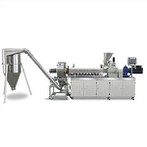
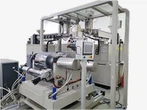
The small precision three-layer coextrusion film blowing machine produced by Guangzhou POTOP consists of three precision single screw extruders, a three-layer coextrusion film blowing die and a film blowing auxiliary machine. It adopts precision extrusion and high-performance film blowing molding technology, with a wide range of process parameter adjustment and wide equipment applicability. It can be used for performance testing of polymer materials and research on blown film molding technology, and is an ideal experimental equipment for high-precision and high-performance film molding.
Scope of application
1. Research and development of new material formula
2. Film blowing performance test
3. Optimization of blown film production process
4. Preparation of three-layer blown tubular film
Product performance
The extruder is driven by a servo motor, ensuring stable plasticization and good consistency;
● Select brand melt pressure and temperature sensors with high test data accuracy;
● Each roller is individually controlled by a servo motor to ensure accurate and stable operation of each roller;
● Computer based measurement and control system and friendly operation interface make it easy to operate and more powerful;
● Real-time measurement and graphic display of important data such as melt pressure and temperature, facilitating observation;
● Emergency shutdown devices and various safety protections ensure the safety of operators.


| Model | unit | |
| Screw diameter | mm | 25 |
| Length to diameter ratio | L/D | 28 |
| Maximum screw speed | rpm | 120 |
| Die diameter | mm | 45 |
| Maximum bending diameter | mm | 128 |
| Linear speed | m/min | 0-35 |
| Maximum temperature | ℃ | 350 |
| Temperature control accuracy | ℃ | ±1 |
| Roll surface width | mm | 220 |
| Main motor power | KW | 3 |