Project Background
In industries such as plastic modification, PVC products, rubber-plastic blending and filled compounding, the performance of pelletizing equipment directly determines part quality and production efficiency. As demand continues to grow for highly filled powder modification, heat-sensitive rubber-plastic compounds and recycled plastic pelletizing, downstream manufacturers are placing higher demands on extrusion pelletizing equipment in terms of feeding stability, plasticizing uniformity, energy-efficient stable operation and material versatility.
A materials manufacturer specializing in PVC modification and highly filled powder pelletizing had long been plagued by feed slippage, uneven plasticizing and thermal degradation when processing high-ratio calcium carbonate and talc-filled formulations on its existing parallel twin-screw extrusion line, leading to inconsistent pellet quality and frequent shutdowns for cleaning.

Key Challenges for the Customer
(1) Difficulty Feeding Highly Filled Powders
With a high proportion of inorganic fillers such as calcium carbonate and talc, the shallow feed section and limited volume of conventional parallel twin screws easily cause bridging and slippage at the feed throat, resulting in insufficient intake, blockage and inconsistent dosing - directly affecting throughput and batch-to-batch consistency.
(2) Uneven Plasticizing and Material Degradation
The short compression path of parallel twin screws leads to uneven melting and shear inside the barrel. Local overheating causes thermal degradation, charring and discoloration of heat-sensitive materials such as PVC, resulting in off-spec pellets, contamination and lower yield.
(3) High Energy Consumption and Maintenance Cost
Aging transmission structures on traditional equipment result in high noise levels and high energy consumption.
POTOP Solution
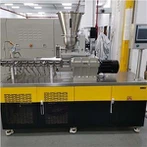
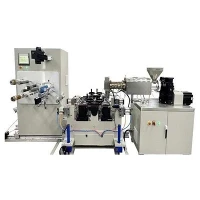
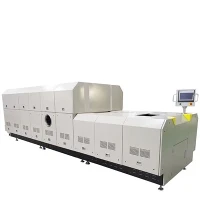
To address these pain points, Potop configured a complete conical twin screw pelletizing extruder package for the customer, integrating a conical screw extruder main unit, intelligent temperature control system, variable frequency drive (VFD) and integrated pelletizing/cutting system, tailored for PVC modification, highly filled powders and heat-sensitive rubber-plastic compounds.
The core of the equipment is its conical screw design - large at the feed end, small at the discharge end: the deep-flighted, large-volume feed section readily accepts highly filled powders and high-percentage calcium carbonate/talc formulations; the progressively tapering discharge end offers a precisely controlled compression ratio, allowing materials to undergo gradual compression, plasticizing and kneading inside the barrel for uniform melting without dead corners.
Core Technical Advantages
(1) Conical Screw Structure Solves High-Filler Feeding
The large-diameter, deep-flighted feed end delivers a significantly larger feeding volume than parallel twin screws of equivalent size, structurally resolving feed slippage, bridging, blockage and insufficient intake. The large feed throughput directly supports industrial-scale continuous production.
(2) Gradual Compression for Dead-Corner-Free Plasticizing
The progressively tapering discharge section provides a long compression path with controllable compression ratio. Materials undergo slow pressure build-up and thorough shear, allowing resin and fillers to fuse gradually and avoiding local over- or under-plasticizing - improving pellet density and uniformity.
(3) Smart Temperature Control & VFD for a Wide Process Window
The machine is equipped with a high-precision VFD and segmented intelligent temperature control, enabling closed-loop regulation of screw speed, barrel zone temperatures and extrusion output. It accommodates pelletizing processes for PVC, PE, PP, thermoplastic elastomers and recycled plastics.
(4) Low-Speed High-Torque Protects Heat-Sensitive Materials
With high torque output and a lower speed range, the machine ensures effective shear and kneading while reducing overheating during residence in high-temperature zones, minimizing degradation, charring and discoloration of heat-sensitive materials like PVC, and preserving the material's original physical and mechanical properties.
(5) Modular Design for Easy Maintenance, Wear & Corrosion Resistance
The barrel and screws are made of wear- and corrosion-resistant materials. The modular design simplifies disassembly, cleaning and color/material changes. The optimized transmission structure lowers operating noise and energy consumption; under proper operation and maintenance, service life of wear parts is extended and maintenance downtime reduced.
Performance and Customer Value
After commissioning, the customer observed noticeably improved feeding stability and extrusion continuity for highly filled formulations, with better pellet density and surface uniformity, and effective control of thermal degradation and discoloration. The machine delivers stable torque output and strong continuous-operation capability suited to mass production; the optimized transmission and temperature control reduce energy consumption and noise compared with the original line. The modular structure shortens routine material changeovers, cleaning and maintenance. With a high degree of automation, operators only need to set parameters and perform routine inspections for stable pellet output. The solution delivers on three fronts simultaneously - quality improvement, energy reduction and downtime reduction - providing solid equipment support for scaled, refined and green manufacturing.
Materials & Applications
The equipment supports pelletizing of general-purpose plastics, modified plastics, recycled plastics and thermoplastic elastomers. Typical applications include PVC modification pelletizing, highly filled calcium carbonate/talc masterbatch, heat-sensitive rubber-plastic compounds, and recycled plastic pelletizing lines, widely serving building products, advanced materials and plastics processing industries.