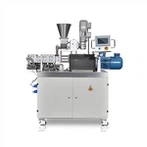
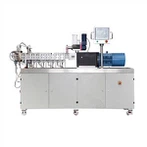
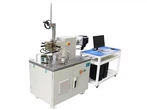
What is wet-process lithium-ion battery separator casting?
Wet-process lithium battery separator (also known as Thermally Induced Phase Separation, TIPS) is the mainstream technical route for high-energy-density power batteries. Unlike dry process which adopts ordinary PP/PE pellets, the core raw materials for wet separators are ultra-high molecular weight polyethylene (UHMWPE) powder, high-boiling white oil and additives. The three components are melted and mixed in an extruder at high temperature to form a homogeneous melt. Then the melt is cast through a slit die and quenched to obtain an oil-containing dense base film.
This oil-containing cast sheet serves as the starting material for subsequent biaxial stretching, white oil extraction and pore formation. The mixing uniformity, thickness consistency and gel structure of the cast sheet directly determine the porosity, pore size distribution and mechanical properties of the final wet separator. Therefore, the front-end casting system is the key equipment for R&D and small-batch production of wet separators.
Applications of the wet-process lithium battery separator casting system
The wet-process lithium battery separator casting system is mainly used for the front-end process of lithium battery separator R&D and small-batch production, to complete continuous mixing, extrusion and casting of raw materials (UHMWPE powder, white oil, additives, etc.).
Simply put, it solves the core challenge in the R&D stage: how to stably prepare oil-containing base film samples with uniform formulation and controllable thickness in the laboratory, which can be directly used for biaxial stretching
Process flow of wet casting
Take the UHMWPE + white oil system as an example, the complete casting process is as follows:
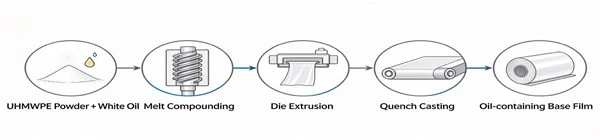
●Continuous feeding and mixing
UHMWPE powder and white oil cannot be simply fed into the hopper like PP pellets. The powder is prone to bridging while white oil is volatile. The wet casting system usually adopts continuous loss-in-weight feeding: powder is accurately metered by a screw feeder, and white oil is injected via a metering pump. Both materials are continuously fed into the extruder at a set ratio (typical UHMWPE : white oil ≈ 15:85 ~ 30:70).
●Melting and compounding via extruder with high L/D ratio
The wet system imposes high requirements on the plasticizing capacity of the screw. UHMWPE features extremely high molecular weight and high melt viscosity. Sufficient shearing in a long barrel is required to fully swell polyethylene molecular chains in white oil and form a homogeneous gel melt. This is why wet casting machines adopt a screw with L/D ratio of 56:1. A longer mixing path ensures full compatibility between white oil and UHMWPE, avoiding oil agglomerates or dry powder residues.
●Die extrusion and casting
After pressure stabilization by a melt pump, the melt enters a coat-hanger slit die. It flows out from the die lip and attaches to a constant-temperature casting roll for quenching. The roll surface temperature is precisely controlled to form a stable gel structure of the oil-containing melt during cooling. It shall avoid internal stress caused by excessive quenching, as well as premature phase separation due to insufficient cooling rate.
●Traction and winding
The cast sheet is traction-wound at a constant line speed. The thickness of the wet base film is generally 0.2~2 mm (much thicker than the 20~25 μm of finished separator), because the sheet will undergo machine-direction stretching, transverse-direction stretching and white oil extraction, leading to dramatic thickness reduction.
| Item | Parameter |
| Applicable Materials | UHMWPE powder + white oil + additives |
| Screw Diameter | 35.5 mm |
| L/D | 56:1 |
| Screw Speed | 0~300 rpm |
| Die Width | 250 mm |
| Product Width | 0~200 mm (depends on materials) |
| Product Thickness | 0.2~2 mm |
| Roll Width | 350 mm |
| Line Speed | 0~10 m/min |
Why are these key parameters designed this way?
●L/D 56:1: The wet system requires a longer melting and mixing section to fully swell and homogenize UHMWPE in white oil, which cannot be achieved by ordinary cast film machines (typically L/D ratio 25~33).
●Product thickness 0.2~2 mm: Wet casting follows the "thick sheet stretching" route. The thick sheet is biaxially stretched and thinned to the final separator thickness. The 0.2~2 mm range adapts to process development for different draw ratios.
●Line speed 0~10 m/min + constant torque motor: Laboratory small-batch production does not require high speed, yet sufficient torque stability is mandatory at low speed. Otherwise, the high-viscosity UHMWPE melt will suffer discharge pulsation and thickness fluctuation. The constant torque motor is designed to solve this problem.
●Die width 250 mm / Roll face width 350 mm: It has margin compared to the maximum product width of 200 mm, facilitating edge trimming and transverse thickness adjustment. Meanwhile, the roll is slightly wider than the die to ensure stable attachment and prevent sheet deviation during casting.
Complete R&D closed loop from cast sheet to finished separator
Process sequence:
Wet casting system (UHMWPE + white oil → oil-containing base film) → Laboratory biaxial stretching tester (MD/TD synchronous or sequential stretching) → Extraction unit (remove white oil by solvent) → Heat setting → Microporous separator finished product
Researchers can complete the following tasks within this closed loop:
●Formulation screening: Adjust UHMWPE grade, white oil content and additive ratio, and observe cast sheet appearance and melting state;
●Process window exploration: Tune extrusion temperature, die temperature, casting roll temperature and traction speed to find optimal conditions for uniform thickness and stable gel structure;
●Stretching linkage verification: Feed cast sheets directly into the biaxial stretching machine, and test microporous morphology, air permeability and mechanical strength under different draw ratios.