Material Pain Points: Inherent Differences Between PVC and General‑Purpose Plastics
PVC (Polyvinyl Chloride) is a widely used chlorine‑containing, heat‑sensitive polymer, fundamentally different from general‑purpose plastics such as PE and PP. PVC raw resin is supplied as fine powder. It must be compounded with stabilizers, plasticizers, fillers, lubricants and other additives before processing into rigid pipe/profile, soft seals, films and other finished goods.
PVC features inherent flame retardancy and excellent resistance to acid, alkali and salt corrosion. However, it has obvious drawbacks as a heat‑sensitive material. Rigid PVC has a long‑term service temperature below 60°C, while soft PVC is limited under 45°C. Local overheating or prolonged material residence will trigger thermal decomposition and release hydrogen chloride (HCl), resulting in yellowing, degradation and invalid test results for flame retardancy, mechanical properties and weather resistance. PVC also turns brittle at low temperatures, and tiny adjustments to additive ratios can cause dramatic performance fluctuations.
PE, PP and other common thermoplastics have good thermal stability and wide processing windows; conventional parallel twin‑screw or single‑screw lab extruders are sufficient for their R&D. Nevertheless, standard extrusion equipment features high shear, rough temperature regulation and bridging risks during powder feeding. Running PVC on these machines frequently leads to three typical issues:
●Local overheating, PVC thermal degradation, yellowed strands and unreliable test data
●Poor dispersion of stabilizers, plasticizers and pigments, low batch‑to‑batch repeatability
●Inability to accept neat PVC powder blends directly; pre‑compounding is mandatory, slowing formulation iteration and making variable control difficult
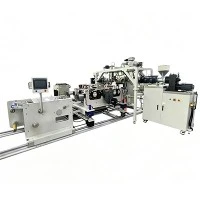
PVC R&D covers rigid PVC profiles & pipes, soft PVC sealing compounds, food‑contact PVC, low‑smoke flame‑retardant PVC and recycled PVC modification. The core R&D requirements are small‑batch trials, multi‑formula screening, precise temperature control, homogeneous mixing and suppression of thermal degradation. The POTOP MGDL‑20/40 laboratory conical twin‑screw granulation extruder is purpose‑built for such chlorine‑containing heat‑sensitive polymer R&D.
Application Scenarios: PVC Formulation R&D, Additive Screening & Performance Validation
This case covers R&D teams from polymer research institutes and PVC new‑material manufacturers. Typical test work includes:
●Comparative tests of different stabilizer systems (Ca/Zn stabilizers, organotin stabilizers, lead‑free eco stabilizers)
●Plasticizer ratio optimization for soft PVC, evaluation of hardness and migration risk
●Filled PVC modification with calcium carbonate or glass fiber, testing rigidity, impact strength and low‑temperature brittleness
●Recycled PVC re‑compounding, devolatilization and degradation control process exploration
Customer pain points of previous equipment: Conventional parallel twin‑screw extruders generate intense shear. PVC strands easily turn yellow and bubble during extrusion. Even with identical formulations, tensile and flame retardant test data show large deviations. Unstable powder feeding and additive segregation make it hard to locate formulation defects, creating large amounts of wasted samples and extended R&D cycles.
Solution: POTOP Laboratory Conical Twin‑Screw Granulation Extruder
Targeted at PVC's heat sensitivity, powder feeding characteristics and multi‑additive compounding requirements, the POTOP MGDL‑20/40 conical twin‑screw extruder is selected for formulation trials.
Core Advantages for PVC Processing:
●Counter‑rotating conical screw design, gentle plasticization to inhibit PVC degradation
The enlarged feed end of conical screws enables smooth powder feeding without bridging. PVC resin powder plus additive blends can be fed directly without prior high‑speed premixing. The gradual compression profile delivers mild shear and avoids localized hot spots. Material thermal history is well controlled to reduce HCl release and yellowing, a major advantage compared with high‑shear parallel twin‑screw extruders.
●Multi‑zone independent precision temperature control + vacuum devolatilization system
Independent heating and cooling loops for each barrel zone, with temperature accuracy up to ±1°C. Operators can set the classic "saddle‑shape" temperature curve for PVC processing. The vacuum vent system removes volatile monomers, moisture and free plasticizer efficiently to reduce bubbles and migration, suitable for low‑VOC and food‑grade PVC formulation development.
●Uniform mixing and high repeatability for controlled comparison tests
Intermeshing counter‑rotating screws ensure consistent conveying and distributive mixing. Stabilizers, plasticizers and fillers disperse evenly in the PVC matrix. Screw speed and feeder rate are infinitely adjustable, supporting single‑variable experiments to quantify how additive dosage affects flame retardancy, tensile strength and low‑temperature impact performance.
●Lab‑scale capacity with easy cleaning for fast multi‑formula iteration
Low throughput for small sample consumption, ideal for frequent formulation switching in academic and industrial labs. Quick‑open split barrel simplifies post‑run cleaning and eliminates cross‑contamination between stabilizer or plasticizer systems, shortening iteration cycles.
●Full‑process data acquisition for traceable extrusion records
PLC intelligent control system continuously logs zone temperatures, screw speed, melt pressure and torque. All process parameters are saved for test repetition, technical papers and scale‑up reference, supporting reliable transfer to production extrusion lines.
Auxiliary Equipment & Process Flow:
PVC powder formulation dosing → Gravimetric feeding → Conical twin‑screw melting & mixing + vacuum devolatilization → Strand extrusion through die → Water bath cooling / air cooling → Strand pelletizing → Sample sealing and storage. Pellets are then sent for tensile, impact, hardness, flame retardancy, thermal stability and migration testing.

Project Trial Results (Based on MASCOM Customer Test Record)
●Stable pellet quality, PVC thermal degradation effectively controlled
From the formal trial record: Extrusion tests were conducted at 170°C and 180°C. The extruded strands maintained good shape, and finished pellets were uniform with smooth surfaces, free from yellowing, bubbles or charring - typical signs of PVC thermal breakdown. The gentle plasticization characteristic keeps PVC within its safe processing window and prevents misjudgment of material performance caused by thermal degradation.
●Single‑variable comparison to identify optimal processing window rapidly
During this trial, screw speed, feeding rate and pelletizer speed remained constant while extrusion temperature was adjusted. Operators directly observed temperature influence on pellet appearance, helping the customer define the suitable processing range for this formulation. Trial videos and pellet samples were submitted together for internal customer evaluation.
●Direct powder feeding, efficient multi‑formula screening
Powder blends of PVC resin and additives can be fed straight into the extruder, eliminating pre‑mixing. In this single trial batch, three custom PVC formulations were compounded and pelletized. Easy cleaning greatly accelerates PVC formulation R&D.
●Smooth process scaling to production lines
Conical twin‑screw extruders are the mainstream machine type for industrial PVC pelletizing and profile extrusion. Temperature, rotation speed and melt pressure data collected on this lab unit can guide commissioning of full‑scale conical twin‑screw production lines and lower scale‑up risks. After successful validation, the machine was fully prepared and delivered to MASCOM for ongoing material R&D.

PVC formulation R&D is far more than simple compounding and pelletizing. The core challenge is achieving good additive dispersion while staying below the thermal threshold to avoid degradation. The process logic of general‑purpose plastic extrusion equipment cannot match PVC's unique material properties.
POTOP MGDL‑20/40 laboratory conical twin‑screw granulation extruder is engineered around real‑world PVC processing requirements. It integrates the strengths of conical screw gentle shearing, reliable powder feeding, precise temperature regulation and vacuum devolatilization on a compact lab platform. This MASCOM PVC formulation trial fully verified that the extruder can run stable powder extrusion and temperature comparison tests and produce uniform, smooth PVC pellets. It provides repeatable small‑batch compounding solutions for overseas advanced material developers and covers the full innovation chain: formulation design, lab sampling, performance testing and industrial scale‑up.