The principle of bidirectional stretching of plastic film is to melt the polymer resin through the extruder after heating the thick sheet at the glass temperature. Under the appropriate temperature range of the high elastic state of the polymer below the melting point through the longitudinal and transverse tension machine is under the action of external forces along the longitudinal and transverse tension of a certain number of times, so that the molecular chain of the polymer in parallel to the direction of the film plane, orientation and orderly arrangement; And the orientation of the macromolecular structure is fixed by heat setting under the stretching state, and finally after cooling and subsequent treatment can be prepared to the ideal plastic film.

During the process of processing, the polymer is constantly undergoing physical and chemical changes. For example, the polymer changes from solid raw material to melt, and then from melt to solid sheet and film, that is, a series of phase transitions occur in the process of material processing; In the process of melting the polymer into sheet and stretching into film, the length, width and thickness of the material is constantly changing shape; In the process of film processing, the polymer undergoes complex crystallization and molecular orientation changes under the action of force, heat and electric field, and also produces different degrees of chemical degradation reactions and surface properties changes.
There are many kinds of plastic film forming processing methods, such as calendering method, casting method, blow molding method, stretching method, etc., of which the stretching method, especially the two-way stretching method, is the most concerned. This is because the plastic film produced by the two-way stretching method has the following characteristics:
1. Mechanical properties are greatly improved. The tensile strength is 3-5 times that of the unstretched film.
2. The barrier performance is improved, and the permeability of gas and water vapor is reduced.
3, the optical properties of the film are improved, and the transparency and surface gloss are increased.
4. The heat resistance and cold resistance of the film are improved, and the dimensional stability of the film is good.
5, the thickness uniformity of the stretched film is better than that of the calendering method and the blow molding method.
6, stretch film production speed, large capacity, high efficiency.
The stretching orientation of plastic film can be divided into uniaxial stretching (also known as uniaxial stretching or longitudinal stretching) and biaxial stretching (also known as biaxial stretching or vertical and horizontal biaxial stretching) two kinds. In fact, due to the large difference in the vertical and horizontal properties after uniaxial stretching, it is less used in the film processing, more used in the processing of plastic fiber, plastic wire and plastic packaging belt. Plastic film is mainly produced by two - way drawing process. There are many kinds of plastic film that can be produced by two-way stretching method, mainly polyester, polypropylene, polyamide, polystyrene, polyvinyl chloride, polyethylene, polyvinyl alcohol and so on.
The bidirectional tester tests thin films in a simple and low-cost manner. The stretching ratio in both vertical and horizontal directions is adjustable, and the maximum stretching ratio is 10:1. The stretching modes can be one-way restricted, one-way unrestricted, two-way synchronous, two-way asynchronous, etc.

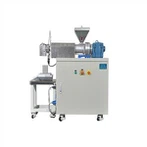
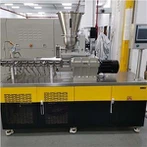
POTOP small Lab Film Biaxial stretcher can be used for bidirectional tensile film material thickness below 3mm, at least 70 square thick film sample, according to the required tensile ratio, in the appropriate temperature and time for film stretching test, physical and chemical testing for laboratory analysis, according to the performance of the sample film, to determine a wide variety of additives and formulas. Then applied to production line, can greatly reduce the cost of trial production. Any bidirectionally stretchable crystalline and non-crystalline polymers, made into thick sheets, can be statically stretched on the machine, such as PP,PE,PET, PPVDF, etc

Lab Film Biaxial stretcher application :
1. New product development and formula optimization;
2. Bidirectional tensile performance test of polymer sheet film;
3. Processing technology evaluation.
The main performance and characteristics of Biaxial stretcher
1. Specially designed tensile mechanism, static pressure box, heating oven, heat shaping box, etc.
2. All drives are driven by well-known brand servo motor, with large torque and stable output;
3, high performance temperature sensor, high accuracy of test data;
4, two-way synchronous stretching and custom two-way stretching can be realized;
5, based on computer measurement and control system and friendly operation interface, easy control, more powerful function