
Film stretching - taking BOPP as an example
In the production process of plastic film, stretching is a crucial link, which not only affects the physical properties of the film, but also directly relates to the quality and application areas of the final product. This article will elaborate on the stretching in the inflation process, stretch orientation, biaxial stretching, and polypropylene (PP) film and its production process.
Basic information of stretching
1. Stretching during inflation
Extruded blown films are often subjected to biaxial stretching. During the blowing process, the diameter of the extruded film tube increases, causing the film to be stretched perpendicular to the extrusion direction. Stretching should be done below the melting temperature and when the polymer is still crystalline, so that the crystals can be oriented. The extruded film tube expands when the polymer is fully melted, so the effect of blowing does not reach the level of orientation with enlarged diameter.
While the film is being blown up by the compressed air, it is also pulled in the direction of extrusion, which results in parallel stretching. Parallel stretching is mostly done after the polymer melt leaves the extruder and when crystallization begins. The crystallization point is called the frost line. At the frost line, the diameter of the film is the largest compared to the area immediately before the frost line, hindering further blowing and stretching. At the frost line, the completely transparent melt becomes foggy due to crystallization. The change in opacity depends on the crystallinity of the various polymers.

1-extruder; 2-feeding hopper; 3-film blowing die head, 4-H-shaped frame, 5-traction roller; 6-air ring, 7-winding roller

(The desktop film blowing machine is mainly composed of a single-screw extruder, a film blowing die head, a film blowing frame, a blower, etc. Take the POTOP desktop film blowing machine in the right figure as an example. The whole machine adopts an integrated structure. The single-screw extruder main unit and the film blowing unit share the same frame and are integrated into one, with a compact structure. The equipment can independently complete the plasticizing extrusion, film blowing, traction and winding of plastics. The film frame can be electrically raised and lowered to facilitate film guiding and process control.The latest machine is equipped with cast film function.)
Sometimes the film is stretched further after inflation, as is the case with shrink film, which shrinks when exposed to heat, allowing for tight packaging.
2. Stretch orientation
Orientation of the polymer must take place between the glass transition temperature and the melting temperature. Polyolefins, especially polypropylene, are normally heated moderately. The enhancement in tensile properties is proportional to the stretch ratio. After stretching, the film should be further heated to relax, set and stabilize its dimensions. In the case of heat shrinkable films, relaxation should not be performed. Crosslinking produced by radiation treatment before stretching can improve the plastic memory effect of the film. Overstretching will produce stress hardening because the folded chain crystals are replaced by straightened crystals. Stress hardened films feel harder and more leathery; they lose elasticity and have a rougher surface.
3. Biaxially oriented (BOPP)
The ideal stretching is to stretch the film in two dimensions, parallel and perpendicular to the flow direction. Parallel stretching occurs when the pulling rate is faster than the extrusion rate. Perpendicular stretching has been described in the production of blown films. In extruded films, the frames that are connected to the edges of the film move towards each other to produce the vertical stretching effect. The frames used are tenter frames. Films are often expanded to three times their original width, while increasing their strength and obtaining thinner films. The stretching process overcomes the bulge effect of the film leaving the die.

Biaxial stretching process of cast film
Material performance application comparison and production overview
Next, we will focus on the popular material polypropylene and its material performance application and comparison:
1. Polypropylene is a sintered polymer. Through the stretching of the film, the molecules are oriented, thereby improving the various properties of the film, increasing the tensile strength, impact strength, transparency and electrical insulation, and reducing the air permeability and moisture absorption. BOPP film is suitable for packaging of various items such as food, medicine, clothing, cigarettes, etc.
And it is used as a base material for composite films in large quantities. BOPP can be divided into ordinary film, cigarette film, pearl film, anti-counterfeiting base film, heat-sealed BOPP film performance standard GB12026-1989, capacitor BOPP film performance standard GB12802-1991.
(1) The raw material is usually 95-97% by mass, 3-5% by mass of random PP, and a polypropylene resin with a melt flow rate of 2~4g/10min. Resins with a large melt flow rate have good fluidity, but a fast crystallization rate and poor sheeting performance. When extruding thick sheets, if the crystallinity is too high, it is easy to become brittle, which directly affects the continuous film forming during biaxial stretching and the performance of the film after stretching.
(2) Production process BOPP film is usually produced by the successive stretching method.
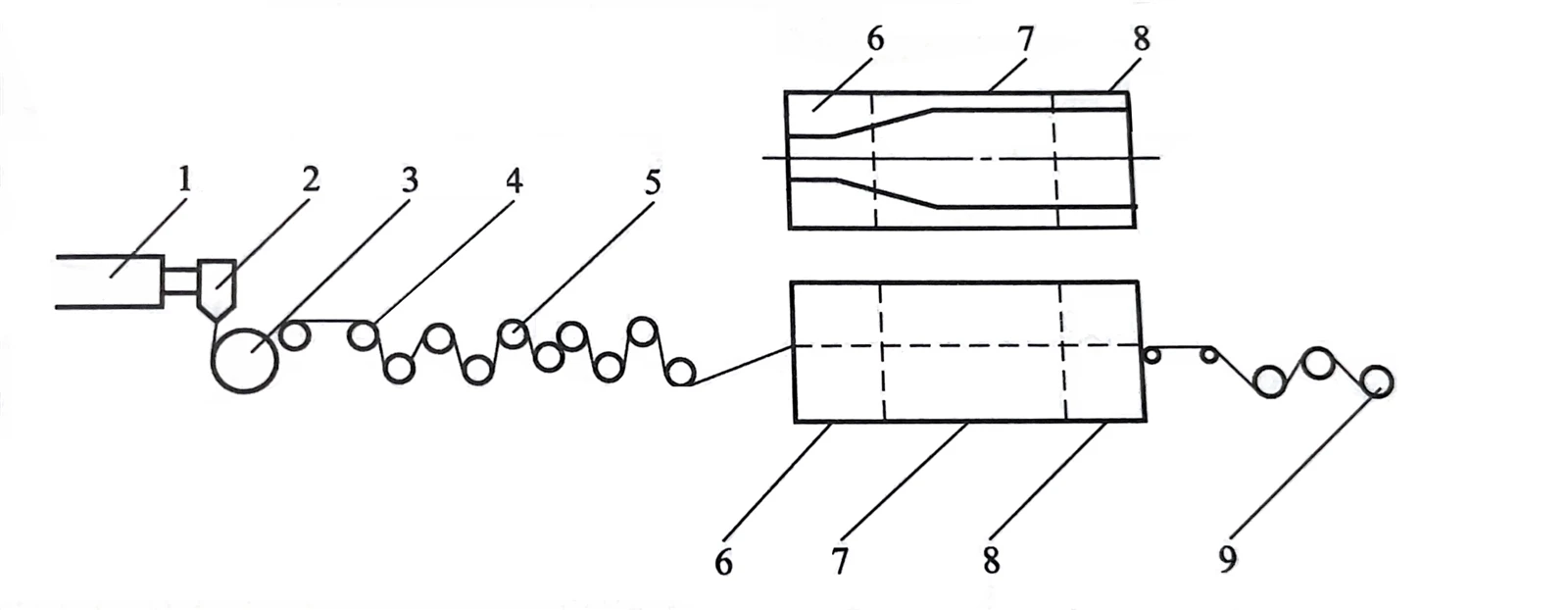
Sequential stretching process flow
1-extruder, 2-T-shaped die head, 3-cooling roller, 4-preheating roller, 5-longitudinal stretching roller
6-transverse stretching preheating zone, 7-stretching zone, 8-heat setting zone, 9-winding machine
2. The production of BOPP film is divided into two parts. The first part is the preparation of thick sheets, and the second part is biaxial stretching.
① Preparation of thick sheets The raw materials are added to the hopper, plasticized by the screw, and extruded into sheets through the coextrusion die. The internal structure of the die is designed with the characteristics of plasticization type and melt fluidity. The sheet thickness is about 0.6mm, and the extruder temperature is controlled at 190~260℃ (heating from the rear of the fuselage to the front). The extruded thick sheet is immediately tightly fitted on the cooling roller by the air knife for cooling. The water temperature is 15~20℃. The prepared thick sheet should be a sheet with a smooth surface, low crystallinity and small thickness tolerance.
② Biaxial stretching First, longitudinal stretching is carried out. The sheet is longitudinally stretched by multiple high-precision metal rollers under heating and at a certain speed gradient to orient the polymer molecules longitudinally. Longitudinal stretching includes single-point stretching and multi-point stretching. The so-called single-point stretching is to control the stretching ratio by the speed difference between the fast roller and the slow roller. There are several heated free rollers between the two rollers. These rollers do not play a stretching role, but only play a heating and guiding role. Multi-point stretching is to install rollers with different speeds between the preheating roller and the cooling roller. The thick film is gradually stretched by the speed difference of each pair of rollers. The gap between the rollers is very small, and sliding is generally not allowed to ensure the uniformity and flatness of the film. Then the horizontal stretching is carried out, and the heating form of hot air circulation is adopted to improve the utilization efficiency of thermal energy and reduce power consumption. The air duct inside the oven adopts a symmetrical structure of two to two, and the upper and lower ovens are also symmetrically distributed, so that the heat distribution inside the oven is uniform, ensuring that the film is heated evenly. Finally, the film is rolled up, and the film after cooling is pulled to the tension control component, flattening roller, friction winding device through the guide roller and traction component, and wound into a film roll of a certain length or a certain amount.

The above picture shows the film biaxial stretching experimental line developed by POTOP, which consists of a five-layer co-extrusion unit, a casting machine, a longitudinal stretching machine (MDO), a transverse stretching machine (TDO), an automatic winding unit, a central control system, etc. The temperature of each roller group is independently controlled, each roller is independently driven and can be steplessly adjusted. The temperature of each zone in the drying tunnel is independently controllable. In the customized mode, it can meet the experimental requirements of various plastic films and various processing technologies such as HDPE, LLDPE, PP, PET, PVDF, PA, etc. depending on the process conditions of the material. It can realize the online stretching of plastic films, and can also prepare longitudinal and transverse stretch films offline.
Conclusion
Due to the inherent characteristics of the biaxial stretching process, the film under this process can expand quickly. The film stretching process is one of the core technologies in plastic film production. Through reasonable stretching orientation and biaxial stretching processing, the physical properties and application value of the film can be significantly improved. In actual production, it is necessary to select appropriate stretching methods and process parameters according to different product requirements and process conditions to ensure Produce high-quality film products.
 facebook
  linkedin
  pinterest
  twitter
  whatsapp
  youtube
  instagram


