Material Introduction
PBAT (Polybutylene Adipate Terephthalate) is a thermoplastic biodegradable copolyester with comprehensive and outstanding performance, copolymerized from adipic acid, terephthalic acid and 1,4-butanediol. It integrates the biodegradability of aliphatic polyester and the mechanical stability of aromatic polyester.
Compared with PLA which features high brittleness, PBAT boasts remarkable flexibility, tear resistance and low-temperature tolerance. It serves as a core raw material for biodegradable films and flexible products, and is also a frequently adopted research material for polymer laboratory equipment manufactured by POTOP.
With a broad processing window and stable melt rheological properties, PBAT is compatible with a wide range of experimental processes including extrusion, cast film extrusion, film blowing, biaxial stretching, mixing and pelletizing. It is resistant to thermal decomposition and easy to form, making it ideal for laboratory formula modification and process adjustment. It is mainly applied in the R&D of disposable biodegradable products such as biodegradable agricultural mulch film, express delivery packaging and food flexible packaging.

Core Physical, Chemical and Processing Properties of PBAT
- Complete Biodegradability
As a fully biodegradable material, PBAT can be completely decomposed into carbon dioxide and water by microorganisms under composting and soil conditions without any residual pollution. Aligned with plastic restriction policies, it is the most widely used biodegradable base material in the industry.
- Superior Mechanical Properties
PBAT features excellent tensile toughness with an elongation at break exceeding 600%. It delivers great impact resistance and bending resistance, and hardly becomes brittle under low temperatures, effectively compensating for the brittleness defect of PLA. Neat PBAT suffers from insufficient rigidity, so it is commonly blended and modified with PLA, starch and calcium carbonate to strike a balance between rigidity and toughness.
- Excellent Rheological Processing Performance
Its melting point ranges from 110℃ to 130℃, with the processing temperature set between 130℃ and 180℃. It maintains stable melt flow and resists thermal degradation and discoloration under wide temperature conditions for compatible equipment. In addition, PBAT has low moisture absorption, requiring no intensive drying and simple pre-processing, thus achieving better molding stability than most other biodegradable materials.
Process Applications of PBAT
Our miniature precision polymer laboratory equipment is tailored to PBAT's characteristics of high flexibility, low crystallinity and wide processing window, supporting the full-chain R&D of biodegradable materials from formula modification, mixing and pelletizing to film forming and stretching modification. Our equipment has been widely deployed for scientific research projects of enterprises and universities.
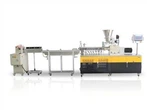
- Twin-Screw Compounding & Modification Pelletizing Experimental Line
To address neat PBAT's drawbacks of poor rigidity and high material cost, this line realizes blending modification of PBAT with PLA, starch, inorganic fillers and other additives. Equipped with uniform shearing, precise temperature control and efficient devolatilization functions, the equipment solves common problems including poor filler dispersion and material delamination & precipitation, so as to stably produce high-performance modified biodegradable masterbatch.

Single/Multi-Layer Co-Extrusion Cast Film Experimental Line
Specially developed for PBAT cast film R&D, it adopts a coat-hanger die with independent segmented temperature control to ensure uniform material extrusion. It can produce single-layer high-toughness PBAT films as well as multi-layer composite films such as PLA/PBAT blends, supporting sample trial production and process debugging for eco-friendly films used in food and medical industries.


Biaxial Film Stretching Laboratory Equipment
The equipment performs machine-direction and transverse-direction biaxial stretching on PBAT sheets. By adjusting processing temperature and draw ratio to optimize molecular orientation, it improves film rigidity, barrier property and dimensional stability, and fixes the issue of excessive softness and easy deformation of pure PBAT films, meeting the R&D demands of high-end biodegradable packaging films.

Film Blowing Experimental Machine
Designed with low-shear extrusion structure to preserve PBAT's inherent outstanding toughness and puncture resistance. It enables stable trial production of biodegradable express wrapping films, garbage bags and agricultural mulch films, facilitating formula iteration, process optimization and product benchmarking tests.

Industrial Applications & Development Prospect
With prominent toughness, excellent moldability and full biodegradability, PBAT is the core flexible base material in the biodegradable materials sector. With miniature precision experimental equipment from POTOP, researchers can efficiently carry out filling blending modification, formula optimization, film process debugging and performance testing of PBAT, greatly shortening the cycle from new material R&D to mass production. Modified PBAT materials have been extensively applied in biodegradable mulch films, eco-friendly packaging bags, disposable food packages, logistics cushioning materials and other finished products.
Against the backdrop of plastic restriction and carbon neutrality policies, PBAT modified materials with high filling ratio, low cost and high performance have become the mainstream R&D direction of the industry. By optimizing production processes with Putong's complete set of polymer molding laboratory equipment, PBAT will further expand its application scope in green packaging, modern agriculture, biomedicine, daily consumer goods and other fields, possessing promising market prospects.