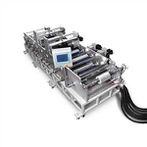
The stretching rate in a biaxial stretching apparatus is a critical parameter that directly affects material behavior. Unlike simple operational variables, it significantly influences microstructural evolution-such as polymer chain alignment and crystallinity-and macroscopic properties, including tensile strength, transparency, and barrier performance.


At a low strain rate, the film material undergoes a more gradual and uniform deformation process. The extended time frame allows the polymer chains sufficient opportunity to respond to the applied external force, facilitating progressive alignment and rearrangement along the stretching direction. This controlled molecular reorganization results in a highly ordered microstructure, which enhances the material's ductility and flexibility.

As the stretching rate gradually increases, the duration for which the film material is exposed to external forces is significantly reduced. The molecular chains within the material do not have sufficient time to fully align and orient themselves, leading to more complex interactions between them. Some molecular chains are subjected to greater external forces before they can stretch, resulting in increased internal stress within the film. Consequently, the film is more prone to experiencing localized stress concentration. On a macroscopic level, a higher stretching rate demands that the film withstand greater tensile forces to deform during the stretching process, and the tensile strength value obtained from testing will be notably higher. However, due to the incomplete orientation of the molecular chains, the film's toughness deteriorates, making brittle fracture more likely, and the elongation at break will consequently decrease.
Changes in the stretching rate not only affect the mechanical properties test data of the film but also have varying effects on its microstructure. The highly oriented molecular structure that forms at a low stretching rate endows the film with specific optical and physical properties, such as improved transparency and uniformity. Conversely, at a high stretching rate, due to stress concentration and the disordered arrangement of molecular chains, defects such as microcracks and voids may emerge within the film. These microscopic defects manifest in macroscopic performance tests and can impact the overall quality assessment of the material.
Different types of film materials have different sensitivities to stretching rates. Some polymer films have strong molecular chain activity and can achieve good molecular orientation and structural adjustment at a lower stretching rate; while other film materials with greater rigidity or stronger intermolecular forces require a relatively high stretching rate to cause significant changes in the molecular chain. Therefore, choosing the appropriate stretching rate for different materials for testing can accurately reflect their true performance.
In the actual test process, if the stretching rate is not selected properly, the test results may be biased and fail to truly reflect the characteristics of the film material. For example, using too high a stretching rate to test a film with good toughness may break the film prematurely, making the test values of tensile strength and elongation at break lower than the actual level; conversely, using too low a stretching rate to test a brittle film may cause the film to creep during the stretching process, which also affects the accuracy of the test results.
To achieve accurate test results when using the film biaxial stretching apparatus, it is essential to choose an appropriate stretching rate based on the film material's properties, the test objective, and industry standards. Maintaining a consistent stretching rate during the test is equally crucial, as any fluctuations can disrupt the material's deformation process and lead to errors in the data. For a more comprehensive analysis, you may conduct tests at various stretching rates and compare the results to better understand the film material's performance characteristics.
The stretching rate film biaxial stretching apparatusprofoundly affects test results, influencing everything from microscopic molecular chain movement to macroscopic mechanical performance. Only through a comprehensive understanding of this influence and the scientific and rational selection and control of the stretching rate can we ensure that the test results are accurate and reliable, providing a valuable reference for the research and development, production, and quality control of film materials.