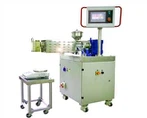
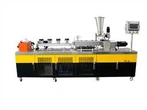
Comparing Twin Screw Extruders and Single Screw Extruders are required by most laboratories, businesses and schools and are essential machines in the plastics processing industry. Based on our experience, the main differences between single and twin screw extrusion technology are listed below.

1. Working Principle: Single screw extruder mainly relies on the principle of positive displacement to transport materials, while twin-screw extruder is based on the principle of forced transportation. In twin-screw extruder, two screws rotate in the same direction, one screw pulls the material into the meshing gap, while the other screw pushes the material out of the gap, so that the material is transferred from one screw groove to the other, to realize the forced conveying of materials.
2. Exhaust: The engaging part of the twin-screw extruder has an effective mixing function, while the self-cleaning function of its exhaust part makes the material get a complete surface renewal in the exhaust section. This gives the twin-screw extruder an advantage in handling certain specific materials, such as the extrusion of thermosetting powder coated materials.
3. Mixing capacity: The engagement zone of the twin-screw extruder has high shear speeds and shear forces due to the interpenetration of the screws and the wide variety of specialized screw designs (e.g. reverse screw elements, kneading blocks, geared mixing elements, etc.) that allow for a precise adjustment of the degree of shear/mixing; thus allowing for the control of the degree of mixing in terms of both mixing intensity and quality of mixing (dispersion vs. distributability). Single screw extruders have a very limited mixing capacity, and any flow restriction that enhances mixing through special screw design will reduce extruder throughput.
4. Volumetric efficiency: The volumetric efficiency of the twin-screw extruder is very high, which makes it more effective in producing products with large cross sections, especially in difficult-to-process materials.
5. Charging method: Twin-screw extruder requires uniform and quantitative charging, and adopts the metering and starvation feeding method. This charging method can make the material enter the extruder can quickly reach a uniform distribution of state
6. Processing flexibility: because the output and screw speed are not limited, and can handle a variety of processing functions in series in an extruder (such as melting, mixing, cooking, exhaust, cooling, etc.) Twin-screw extruder processing flexibility. On the contrary, single-screw extruder output and screw speed is dependent on each other, the series of multiple processing functions of the screw design is limited.
7. Residence time: in the twin-screw extruder, the residence time of the material is very short, not easy to produce local degradation and deterioration. This is mainly due to the self-cleaning nature of the twin-screw extruder, i.e., due to the opposite direction of the speeds of the screw prongs and the screw grooves in the engaging area, the relative speeds are high, so that they can scrape away any buildup of material adhering to the screw.
8. Range of application: Single-screw extruders are usually used for the production of simple plastic products, such as plastic pipes, plastic sheets and so on. Twin-screw extruders, on the other hand, are more suitable for the production of complex plastic products, such as plastic films, composite materials and so on.

Overall, single-screw and twin-screw extruders are the most common tools in the plastics industry and are widely used in injection molding, blow molding, blown film and other fields. Single-screw extruders and twin-screw extruders each have their own characteristics and scope of application. When choosing which one to use, you need to make comprehensive consideration based on factors such as production needs, product requirements and budget.