1.Olefin Polymer
Olefin polymers such as HDPE and BOPP are crystalline polymers. It has excellent performance, good barrier properties, high impact strength, and is a highly transparent packaging material. Olefin polymer film is an ideal packaging material. The barrier performance of olefin polymers depends on their own molecular weight and crystallinity. Therefore, high-density olefin polymers are generally chosen as barrier materials, or directional stretching processes can also improve their barrier performance. Sometimes, in order to improve its barrier performance, a multi-layer co extruded composite film is usually formed with other specifications of polymers. For example, MPVA/BOPP, EVOH/PE, and EVOH/PP are packaging materials with high or ultra-high barriers.
2.Polyester
Polyester and polyolefins are both crystalline polymers, and the difference in crystallinity is not significant, but their molecular polarity is different. Due to the presence of polar groups in polyesters, intermolecular attraction increases, resulting in better barrier properties than polyolefin polymers. Polyethylene terephthalate (PET) is a transparent polymer material, but its disadvantage is poor heat resistance. Poly (butylene terephthalate) (PBT) has better heat resistance than PET. In recent years, the newly introduced poly (ethylene naphthalate) (PEN) has a similar structure to PET, but the naphthalene ring is a larger conjugated molecular structure than the benzene ring, so the molecular chain is rigid and more planar. It has the following advantages when used in containers:
① Good gas barrier (approximately 5 times that of PET);
② It can absorb ultraviolet rays with wavelengths below 383nm, which can prevent food spoilage caused by ultraviolet radiation;
③ High glass transition temperature and good heat resistance;
④ Good chemical resistance. It has better barrier properties (especially blocking oxygen and ultraviolet rays) and heat resistance. Its main drawback is that the cost of raw materials is too high, therefore, PEN can be blended with PET to form a PEN/PET blend to reduce costs.
3. Polyamides (nylon series)
Nylon is another series of barrier materials. The barrier performance of general nylon for O ₂ is 2-3 times that of polyester and 70-140 times that of polyolefin. The barrier performance of amorphous nylon is better than that of crystalline nylon. An important characteristic of amorphous nylon is that its barrier performance improves with increasing temperature, especially suitable for high temperature and high humidity situations. Another important characteristic of barrier nylon is that its strength is much higher than other types of barrier materials. Usually, nylon and low density polyethylene are co extruded to produce 3 or 5 layers of barrier packaging film for use.
4.Inorganic oxide coated film
PVDC, which is widely used as a high barrier packaging material, has a trend of being replaced by other packaging materials due to its waste generating HCl during combustion treatment, leading to environmental pollution issues. The so-called coating film obtained afterwards has received attention, in addition to silicon oxide coating, there is also aluminum oxide evaporation coating film. Its airtightness performance is the same as that of the silicon oxide coating obtained by the same method.
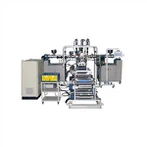
The Biaxial Stretcher produced by Guangzhou POTOP is suitable for materials such as PET, PA, PP, PS, EVA, PVDF, PTFE, etc. It can be used as thick film samples of biaxially stretched film materials with a thickness of less than 0.2-2mm and a thickness of 70-100mm square meters. According to the required stretching ratio, film forming and stretching experiments are carried out at suitable temperature and time for laboratory physical and chemical testing and analysis. Based on the performance of the sample film, a variety of additives and formulas are determined. And applied to the production line, it can greatly reduce the trial production cost. Any thick sheet made of crystalline and amorphous polymers that can be used for biaxial stretching can be statically stretched on this machine.
|
Item |
FOCI - 05 |
FOHI - 05 |
FOCI - 10 |
FOHI - 10 |
|
Applicable materials |
PE、PP、PET、PTFE、PVDF etc |
|||
|
Maximum sample thickness |
50 μm - 1.5 mm |
20 μm - 2mm |
||
|
Minimum sample size |
80×80mm |
80mm×80mm |
||
|
Maximum stretching speed |
10 - 300 mm / s |
0 ~ 500 mm / s |
||
|
Stretch mode |
双向同步、双向异步 |
|||
|
Speed mode |
恒定速率 / 恒变速率 |
|||
|
Stretch ratio |
5 : 1 |
10: 1 |
||
|
Tensile force |
1000 N |
2000 N |
||
|
Maximum temperature |
250 ℃ |
350 ℃ |
250 ℃ |
350 ℃ |
|
Overall power |
30 kW |
60 kW |
135 kW |
175 kW |
|
Working Voltage |
3相交流380V ,50Hz |
|||
|
Control mode |
Siemens PLC控制 |
|||
|
Overall size |
2900×1400×1700 mm |
5000×2100×1900 mm |
||