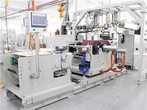
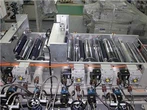
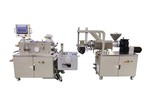
The high‑end new polyester material industry is experiencing rapid development. As a strategic high‑grade polyester, Polyethylene Naphthalate (PEN) is widely applied in 5G high‑frequency substrates, flexible displays, lithium‑ion battery packaging, high‑barrier food packaging, photovoltaic backsheets and other fields. Domestic PEN pellets have gradually achieved local production, breaking overseas monopolies. Nevertheless, the unique physical and chemical properties of PEN raise technical barriers for film forming R&D and hinder its industrial implementation. To address these challenges, Potop has independently developed the Cast‑Blown Film Integrated Machine for PEN pellet forming research, delivering a complete experimental solution for technological iteration and new‑product realization of domestic PEN films.
Basic Introduction to PEN Material
Polyethylene Naphthalate (PEN) is a high‑performance aromatic polyester synthesized via polycondensation of dimethyl‑2,6‑naphthalenedicarboxylate and ethylene glycol. It represents an advanced upgrade of PET. Unlike the benzene‑ring structure of PET, PEN features stiffer naphthalene rings on its molecular backbone, delivering superior comprehensive performance and making it a core raw material for high‑end precision films. Domestic manufacturers have made continuous breakthroughs in polymerization, purification and modification technologies. The stability of domestic high‑purity, high‑molecular‑weight PEN pellets keeps improving, reducing reliance on imported feedstock and supporting the localization of downstream high‑end films.

Key Performance Advantages of PEN
Compared with conventional polyesters such as PET, PEN offers prominent overall performance to satisfy stringent high‑end application scenarios. Its main strengths are reflected in four aspects:
●Excellent thermal stability: PEN has significantly higher glass‑transition temperature and thermal decomposition temperature than PET, with extremely low thermal shrinkage. It withstands high‑temperature processing and long‑term service under thermal conditions, resisting deformation, aging and performance degradation, well‑suited for photovoltaic and new‑energy applications.
●Ultra‑low high‑frequency dielectric properties: Low dielectric constant and dielectric loss minimize signal interference and transmission loss under 5G high‑frequency conditions to ensure stable operation of high‑frequency circuits. PEN is a preferred material for premium high‑frequency electronic substrates and flexible circuit boards.
●Outstanding gas‑barrier performance: Its oxygen and water‑vapor barrier capacity reaches 3‑5 times that of ordinary PET. It effectively blocks moisture and air to meet high‑barrier requirements for premium food, sterile pharmaceutical packaging and moisture‑proof storage of lithium‑battery electrodes.
●Superior weather resistance and dimensional stability: Good hydrolysis resistance, chemical corrosion resistance and tensile properties enable reliable performance in humid, acidic and alkaline environments. Molded parts maintain high dimensional accuracy and long service life for long‑term use of sophisticated high‑end products.

Core Processing Challenges of PEN Pellet Film Forming
Despite its outstanding performance, PEN's special molecular structure leads to difficult processing, classifying it as a hard‑to‑process polyester and limiting large‑scale commercialization. Three major pain points are summarized below:
●High processing temperature and narrow processing window:
PEN requires higher forming temperatures than common polyesters with a narrow stable processing range. Minor temperature fluctuations may trigger thermal degradation of polymer melt and impair mechanical and electrical properties, demanding strict uniformity and precision of equipment temperature control.
●Poor melt fluidity and frequent forming defects:
Due to its distinctive crystallization behavior and poor melt flow, blown‑film processes tend to suffer unstable bubble geometry, wrinkles and film rupture. Cast films frequently show thickness deviation, gel particles, pinholes and scratches, making high‑quality sample preparation difficult.
●Difficult formula adaptation and low R&D efficiency:
Process parameters vary greatly across different grades and modified PEN materials. General‑purpose equipment lacks sufficient adjustment accuracy and stability. Formulation tuning and sample preparation take long cycles with low success rates and slow down industrial progress.

Cast‑Blown Film Integrated Machine: Targeted Solution for PEN Forming R&D
Lab‑scale R&D of PEN films places stringent requirements on equipment integration, control accuracy and data traceability. Conventional standalone machines cannot support both cast‑film and blown‑film process optimization. Targeting the above‑mentioned bottlenecks, Potop independently developed the Cast‑Blown Film Integrated Machine, a dedicated lab equipment for formula development and sample preparation of PEN and other special polyesters.

Adopting an integrated design, the unit incorporates precision extrusion, cast‑film, blown‑film, traction and winding modules. Operators can rapidly switch between the two forming processes without line disassembly and reassembly, saving R&D investment, floor space and time. It fits university research, corporate new‑product development and customer sample validation.
Core hardware is engineered for PEN's harsh processing conditions: a ±1 ℃ high‑precision closed‑loop temperature‑control system meets PEN's high‑temperature forming requirements and suppresses melt thermal degradation. A precision metering extrusion screw provides stable and quantitative melt delivery to mitigate thickness variation, gel particles and film breakage, enabling consistent production of high‑quality PEN film specimens.
Equipped with a full‑process data‑traceability system, the machine automatically logs temperature, screw speed, blow‑up ratio, traction tension and winding tension. Recorded data facilitates experimental review, accelerates determination of optimal parameters for various grades and modified PEN, and shortens R&D and validation cycles.
Beyond the integrated machine, POTOP supplies supporting instruments including rheometers, tensile testers and biaxial stretching machines to build a complete R&D platform covering pellet testing, compounding & modification, film forming and performance characterization. The complete experimental workflow closes the loop of "pellet formulation - process validation - film specimen", facilitates industrialization of domestic PEN films and advances the independent controllability of the high‑end polyester industrial chain.