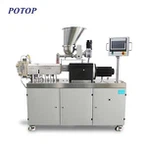
Control stress type. This type of rheometer is the most widely used. The motor of this type of rheometer product uses a cup motor. The cup motor is an asynchronous AC motor with small inertia, which is particularly suitable for low-viscosity sample testing; while the rheometer using a permanent magnet DC motor, The inertia is slightly larger, but in principle, the response speed is fast, which is also the current development direction of stress rheometers. This type of rheometer uses a motor to drive the clamp to apply stress to the sample, and at the same time uses an optical decoder to measure the resulting strain or rotation speed.
Control the strain type. The DC motor of this rheometer is installed at the bottom, and strain is applied to the sample through the clamp. The upper part of the sample is connected to the torque sensor through the clamp to measure the generated stress; this rheometer can only do a simple strain control experiment because of the torque. The sensor needs a rebalancing time to generate deformation when measuring torque, so the response time is relatively slow, so that the stress cannot be controlled through the feedback loop. Due to the complicated hardware of the rheometer for strain control, there are currently only a few functional accessories to choose from.