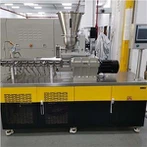
Common problems of screw extruders and their treatments. In the use of mechanical equipment, it is inevitable to have one or another problem. Therefore, it is very important to find the problem in time and find a solution in production. Here we analyze some common problems of screw extruders and discuss the best treatment methods.
1. Common problems and treatment methods of extruder
1. If you do not eat the material, the phenomenon of "leakage" and screw heating will occur.
1.1 Reasons and methods
1.1.1 The reamer is severely worn. The gap between the reamer and the inner wall of the mud tank is too large, or the helix angle of the reamer blade is not correct. When replacing the reamer, pay attention to keeping the gap between 3 and 5mm, and make the reamer blade according to the designed angle.
1.1.2 The surface of the reamer blade is too rough, and the friction between the mud and the blade is too large. Therefore, do not build up the reamer when surfacing the reamer. Replace all at a time. It should be replaced gradually and in batches to ensure smooth output. brick.
1.1.3 The liner of the mud tank wall is severely worn. The gap between the reamer blade and the mud tank wall is too large, which causes the mud to rotate too much in the mud tank, and the mud cannot come out or get in. At this time, a new mud tank liner should be replaced, or a number of ribs parallel or inclined to the axial direction should be installed on the inner wall of the liner to replace the rifle grooves that have been worn away to prevent the ineffective rotation of the mud and increase its effectiveness. Extrusion.
1..1.4 The clearance between the squeegee blade and the reamer is too large to hold down the mud. At this time, the blade should be adjusted or repaired and updated to make the clearance between the blade and the reamer less than 10mm.
2. Mud bar movement bending
2.1 Reasons and methods
2.1.1 The mud bars are bent to one side. This is caused by the misalignment of the center lines of the machine mouth, core tool, mud cylinder and screw cutter or the tilting of the roller bed, which can be solved by adjusting the position.
2.1.2 S-shaped bend appears in the mud bar. This is due to the insufficient compression length of the neck of the machine, the top of the main and auxiliary blades of the first spiral reamer are not aligned, or the auxiliary blades of the first reamer are severely worn and become smaller, causing only the semicircle of the main blade to push out the mud during operation. . At this time, the first reamer should be dismantled and replaced, and the auxiliary blades should be welded and repaired.
3. Overload
3.1 Reasons and methods
3.1.1 The mud is too dry. At this time, you should first take out the mud that is too dry, it is best to remove the machine mouth and head, start the machine to drain the dry material in the mud tank before installation and operation, and appropriately increase the molding water within the specified range.
3.1.2 When the machine is stopped for a long time, the remaining material in the mud tank becomes dry and hard, which will not only cause serious overload, but sometimes fail to start. In order to prevent this from happening, do not turn off the water at the machine port when the machine is shut down for more than 8 hours. For the two-stage vacuum extruder, the mud in the upper mud tank should be properly supplied with water to keep it moist. If the machine is shut down at 2 If it is more than a few days old, try to empty the mud before stopping the machine.
3.2 Precautions: When overloading, the load of the motor will remain high and the clutch will slip. At this time, do not force it to start, so as not to damage the relevant parts, or even cause major accidents such as squeezing the mud cylinder and the nose.
4. The machine "swing head"
4.1 Reasons and methods
4.1.1 "Swing head" is a common problem of screw extruders. This is because the reamer shaft is a long cantilever shaft with poor stability. When the bearing is loose, the main shaft is bent, and the auxiliary blade of the first reamer is too large. Hours will exacerbate this situation. If the mud tank is not installed correctly, the clearance between the spiral cutter blade and the cylinder wall is not the same, and the outer edge of the spiral cutter blade is severely out of round, causing uneven force on the main shaft and swinging the head, it should be corrected in time and often Tighten the anchor bolts and connecting bolts to prevent their heads and tails from swinging.
5. Spiral lines appear after the mud sticks are extruded
5.1 Reasons and methods
5.1.1 Due to the spiral action of the reamer, the advancing speed of the mud in the mud tank section is inconsistent, the mud near the axis moves faster, the mud at the edge moves slowly, and the mud flows with different speeds An interface is formed, and water and air are concentrated in the gaps on the surface, resulting in delamination. The main reasons are the high plasticity of the mud, excessive moisture in the molding process, too high spindle speed, and mud return on the inner wall of the mud tank. The treatment method is as follows:
(1) Raw materials of different properties should be fully mixed and evenly mixed, so that the moisture can fully penetrate into the raw material particles and reduce the moisture on the surface of the raw mud.
(2) Appropriately reduce the forming moisture to increase the friction between the mud layers. [2]
2. Common problems and solutions for finished bricks
1. hair-like cracks
Shallow and thin cracks appear on the surface of the bricks, and there are basically no linear cracks, and sometimes the cracks extend to the strip surface or the top surface. Most of these are hidden dangers left during molding, and improper use of brakes during firing has caused cracks to expand. For this reason, the plasticity index of the raw materials should be appropriately reduced, the rotation speed and helix angle of the screw cutter of the brick machine should be adjusted, and a separate screw cutter should be used, and a mud stick should be added to the mud tank to reduce the stratification of the mud; or use hot water, Steam agitation, vacuum squeezing mud and other measures to reduce the water and air in the mud to eliminate stratification; in addition, the roasting should use the gate correctly, uniformly drain the moisture, and implement the gate front gate in stages.
2. Burst
When the residual moisture of the bricks entering the kiln is too high, and the heating rate in the initial stage of the preheating temperature exceeds 25-35℃/h, the rapidly vaporized steam in the bricks will not be discharged in time, and the bricks will be squeezed. The higher the residual moisture, the more the situation will be. Seriously, even the kiln roof can be heard cracking, especially after the squatting fire enters the pre-heating zone, the temperature is more rapid, and the moisture content of the death and injury is not too high. The water vapor often only squeezes the surface of the bricks to form cobweb-like fine cracks. In addition to controlling the residual moisture into the kiln billet to be less than 8%, the pre-heating zone should be appropriately extended to make the temperature rise slowly and evenly dewatered, and the gate should be raised slowly after squatting fire and paper burning in the wheel kiln.
3. Pan frost
A layer of white powder grows on the surface of the brick, which is the residue after the brick body contains magnesium sulfate, sodium sulfate and other soluble inorganic salts, which ooze out after absorbing water and evaporate on the surface. Since the green body contains a certain amount of crystal water, it expands after dehydration, so the surface layer of the brick will crack when it is frosted. For this reason, the content of twisted magnesium in the mud should be controlled below 3%. Strengthen the pulverization, improve the fineness and appropriately extend the roasting and holding time, so that the water-insoluble silicate is formed, and the harm is reduced or eliminated.
4. Mute brick
In addition to the dumb bricks caused by insufficient fire, the invisible cracks caused by the molding and the invisible layering left by too much impurities in the raw material soil and uneven mixing, the wet bricks are preheated too quickly, and the bricks that have been frosted Micro-cracks will be formed in the pre-heating zone and the bricks will cause moisture absorption and condensation, which will cause the dull bricks, the sudden cold of the body and the formation of micro-cracks, etc., and may also cause the dull bricks. In this regard, in addition to strengthening the processing of raw materials, removing impurities, fully mixing, and improving the relevant parameters of the brick machine, attention should also be paid to not burning high-temperature billets and frost billets. At the same time, it should be ensured that the preheating is good and there is a sufficiently long insulation belt.
5. The brick surface is scorched and blisters
The reason is that the baking zone heats up too fast, the surface layer melts and sinters quickly, blocking the pores, and the gas generated by the physical and chemical reactions still going on inside has no way to go, and bubbles are formed on the brick surface. Therefore, the heating rate of the roasting zone should be lower than 40-70℃/h, especially when the green body has reached the temperature above 900℃, the temperature of the continuous heating is lower than 20℃-30℃/h to prevent the brick surface from scorching. bubble.