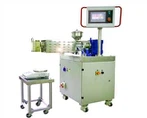
Product Overview
The conical twin-screw extruder is an industrial equipment used for the compounding and extrusion molding of thermoplastic plastics. It is mainly used for the direct molding of pipes, sheets, and profiles from materials such as rigid polyvinyl chloride (UPVC), and also has functions for plastic modification and powder granulation. It follows the principle of "volumetric extrusion + forced propulsion," employing a counter-rotating design. The screw has a conical structure with a large diameter feeding section and a small diameter homogenizing section. The material is forced to be extruded and propelled from the large end to the small end, making it suitable for processing heat-sensitive and high-viscosity materials.

The conical screw design creates a dual compression ratio, allowing for more complete material plasticization. Its core advantages lie in high-pressure plasticization and stable molding, making it particularly suitable for processing heat-sensitive materials such as PVC. Its core applications are molding and high-pressure processing of heat-sensitive materials, primarily in the PVC processing field, but it is also suitable for wood-plastic composites and precision laboratory processing. The high-efficiency, energy-saving conical co-rotating twin-screw extrusion technology combines the advantages of conical counter-rotating and parallel co-rotating twin-screws, featuring high output and low energy consumption.

Features: Stable quality, high output, and wide applicability.
The conical twin-screw extruder is a type of twin-screw extruder. Based on whether the centerlines of the two screws are parallel, twin-screw extruders can be divided into cylindrical (parallel) and conical (tapered) twin-screw extruders.

Its core feature is that the two screws are tapered and gradually change shape, with their axes at a certain angle (usually 30°-45°). The feeding section has a larger diameter, while the homogenization section has a smaller diameter. Conical twin-screw extruders follow the principle of "volumetric extrusion + forced propulsion," and most employ an anti-rotation design. This design naturally gives it a dual compression ratio formed by the variation in screw channel depth and the gradual change in screw diameter, resulting in more complete material plasticization. It is particularly suitable for processing heat-sensitive and high-viscosity materials such as PVC.

Its component composition is basically the same as that of a single-screw extruder, the difference being the presence of two conical screws within the barrel. During meshing operation, the conical twin-screw extruder has a larger space at the tail bearing position, resulting in a more compact bearing arrangement, with the transmission system primarily designed to withstand radial pressure.
With appropriate molds and auxiliary production lines, PVC powder can be directly processed into plastic products of different cross-sections, such as pipes, sheets, and profiles. Its core structure consists of conical twin screws, a barrel, a temperature control system, and a transmission device, and it can be adapted to variable frequency speed control motors and intelligent control systems for energy-saving operation.
The conical twin-screw extruder features uniform plasticizing and mixing, high output, stable quality, wide adaptability, long service life, and direct molding of PVC powder. Equipped with appropriate forming die heads and auxiliary equipment, it can directly extrude various thermoplastics, especially rigid PVC powder, into plastic products such as pipes, sheets, plates, rods, films, and profiles. It can also perform modification of various plastics and powder granulation processes.

The conical twin-screw extruder has stable performance and can plasticize and extrude the melt well at a relatively low temperature. The barrel is equipped with a cast aluminum heater, which has high thermal efficiency, rapid and uniform heating, and is also equipped with a cooling fan.

The specially designed transmission system utilizes a new type of variable frequency motor or direct-drive motor, ensuring smooth operation, high transmission torque, and high efficiency. Stepless speed regulation is achieved through imported frequency converters or DC speed controllers, offering high precision and energy savings. An intelligent dual-display digital temperature controller provides high control accuracy and minimal temperature fluctuations. Features include overload protection and fault alarms, constant temperature circulation in the screw core, and barrel oil cooling. It is also equipped with a vacuum exhaust pipe and a quantitative feeding device.