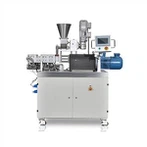
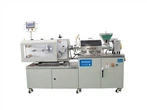
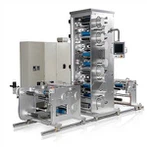
It is a key component of the extruder. The performance of the screw determines the productivity, plasticization quality, dispersion of additives, melt temperature, power consumption, etc. of an extruder. It is the most important part of the extruder, and it can directly affect the scope of application and production efficiency of the extruder. Through the rotation of the screw to produce extreme pressure on the plastic, the plastic can move, pressurize, and obtain some heat from friction in the barrel. The plastic is mixed and plasticized during the movement of the barrel, and the viscous fluid is melted. When the body is extruded and flows through the die, it obtains the desired shape and is formed. Like the barrel, the screw is also made of a high-strength, heat-resistant and corrosion-resistant alloy.
As there are many types of plastics, their properties are also different. Therefore, in actual operation, in order to adapt to different plastic processing needs, the types of screws required are different, and the structure is also different. In order to maximize the efficiency of plastic transportation, extrusion, mixing and plasticization.
The basic parameters that express the characteristics of the screw include the following points: diameter, length-to-diameter ratio, compression ratio, pitch, groove depth, helix angle, screw and barrel gap, etc.
The most common screw diameter D is about 45 to 150 mm. As the diameter of the screw increases, the processing capacity of the extruder increases accordingly. The productivity of the extruder is proportional to the square of the screw diameter D. The ratio of the effective length to the diameter of the working part of the screw (referred to as the length-to-diameter ratio, expressed as L/D) is usually 18-25. Large L/D can improve the temperature distribution of the material, facilitate the mixing and plasticization of plastics, and reduce leakage and backflow. Improve the production capacity of the extruder. The screw with a large L/D is more adaptable and can be used for the extrusion of a variety of plastics; but when the L/D is too large, the plastic will be degraded due to the increase of heating time. The increase in self-weight and the deflection and sagging of the free end can easily cause scratches between the material and the screw, and make manufacturing and processing difficult; and increase the power consumption of the extruder. A screw that is too short may easily cause poor plasticization during mixing.
The half of the difference between the inner diameter of the barrel and the diameter of the screw is called the gap δ, which can affect the production capacity of the extruder. As δ increases, the productivity decreases. Usually, it is appropriate to control δ between 0.1 mm and 0.6 mm. If δ is small, the shearing effect of the material is greater, which is conducive to plasticization, but if δ is too small, the strong shearing effect is likely to cause thermomechanical degradation of the material, and at the same time it is easy to cause the screw to be hugged or rub against the barrel wall, and If δ is too small, there is almost no leakage and reverse flow of the material, which affects the mixing of the melt to a certain extent.
The helix angle Φ is the angle between the screw thread and the cross section of the screw. As Φ increases, the production capacity of the extruder increases, but the shearing effect and extrusion force on the plastic decreases. The helix angle is usually 10° to 30 Between °, it changes along the changing direction of the screw length, often equidistant screws are used, the pitch is equal to the diameter, and the value of Φ is about 17°41′
The greater the compression ratio, the greater the extrusion ratio received by the plastic. When the screw groove is shallow, it can produce a higher shear rate for the plastic, which is beneficial to the heat transfer between the barrel wall and the material. The higher the efficiency of material mixing and plasticization, the productivity will decrease; on the contrary, when the screw groove is deep. The situation is just the opposite. Therefore, heat-sensitive materials (such as polyvinyl chloride) should use deep groove screws; while plastics with low melt viscosity and high thermal stability (such as polyamide) should use shallow groove screws.