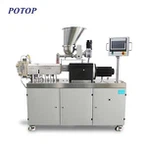
The torque rheometer is equipped with screws with different parameters that rotate within a cylinder with a certain temperature, and a feeding hopper is installed at the other end of the cylinder. When the raw material is sent to 2/3 of the cylinder, it gradually plasticizes and enters the remaining part of the cylinder to be homogenized. After all particles are dissolved, the capillary extrusion mold can be used to become the master material or injected into the mold for forming. At the same time, the equipment also measures the relationship between the material's apparent viscosity, shear rate, and shear stress.

The torque rheometer support software set consists of the apparent viscosity testing software plastic and the apparent viscosity testing data processing software WinNian. Plastic software can collect and control experimental data through the serial port of a PC, as well as establish a human-machine information interaction interface. This interface has relatively complete functions and can complete 6 temperature measurement and control, including speed setting, measurement and control, torque and pressure measurement, etc. The curve window can display real-time curves of the above data over time. These data can be processed by dedicated WinNian.
When the screw speed of the extruder is changed, the pressure difference P between the inside and outside of the die and the extrusion flow Q value can be changed. The experimental data can be saved in the form of a file. This file is opened in the software WinNian, and representative data is filtered to automatically output the g-h, g-t curves of double logarithmic coordinates.

Basic structure of torque rheometer
Microcomputer control system: used for setting experimental parameters and displaying experimental results;
Electromechanical drive system: used to control the experimental temperature, rotor speed, pressure, and record the changes in temperature, pressure, and torque over time;
Replaceable experimental components: Generally equipped with sealed mixers or screw extruders as needed.
Function of torque rheometer
When the torque rheometer is working, the material is added to the mixer and subjected to the force exerted by two rotors with the same rotational speed and opposite directions, causing the material to undergo mixing and shearing between the rotor and the chamber wall. The material exerts a reaction force on the rotor, which is measured by a force sensor and converted into a torque value. The magnitude of the torque value reflects the viscosity of the material. By controlling the temperature of the rotor through thermocouples, the viscosity of the material at different temperatures can be obtained. The torque rheometer can be used to study the thermal stability, shear stability, flow and curing behavior of thermoplastic polymer materials. Its biggest feature is that it can continuously, accurately and reliably measure the rheological properties of the system in similar actual processing processes.

Characteristics of torque rheometer
1)Strong functionality:
In addition to basic extruders and mixers, it is also equipped with automatic weighing units, diameter measuring units, strip sample pressing and traction units, and film quality testing units. By utilizing these units, more testing work can be completed. For example, using an automatic weighing unit, it is possible to automatically measure the relationship between material apparent viscosity, shear rate, and shear stress, while using a diameter measuring unit to automatically measure the expansion of the mold. A uniform strip sample can be made by using the strip sample pressing and traction unit for tensile and thermal extension experiments. By using the membrane quality testing unit, it is possible to test the impurities, particle defects, and transparency of transparent materials.
2) Rich software:
The torque rheometer is an automated testing instrument centered on a computer. Data collection, control, and experimental data processing are all completed by corresponding software, which not only manifests as convenient instrument operation, control, experimental data processing, and result output. More importantly, with the support of software, perform functions that traditional torque rheometers cannot perform, such as measuring the shear sensitivity characteristics of materials through linear acceleration. Mouth correction during the measurement of the relationship between material apparent viscosity and shear rate.
3)High performance to price ratio:
The design concept of torque rheometer is to achieve functional expansion and performance improvement through software development without increasing hardware equipment as much as possible, thus having a high performance price ratio.
4) Strong scalability:
The torque rheometer was successfully developed by a team of experts from various fields such as electrical and automation, machinery, materials, and computer. The development team is able to track international cutting-edge technologies and implement them specifically in the product, ensuring that the product maintains strong scalability.
Application of torque rheometer
With the deepening of research on the application of torque rheometer and the expansion of its functions, it has become an essential tool in polymer processing and experimental rheology, and can be widely used in the research, development and product quality control of raw materials and production processes.
Every torque rheometer manufactured by Guangzhou POTOP can meet high standard performance requirements. It is a professional torque rheometer manufacturer that strictly controls the manufacturing process and non-standard equipment project progress of each equipment. The spare parts used in the equipment are strictly audited, and every component of each equipment is fully inspected. From design, procurement to production, pay attention to every detail.